
Tree Removal & Stump Grinding
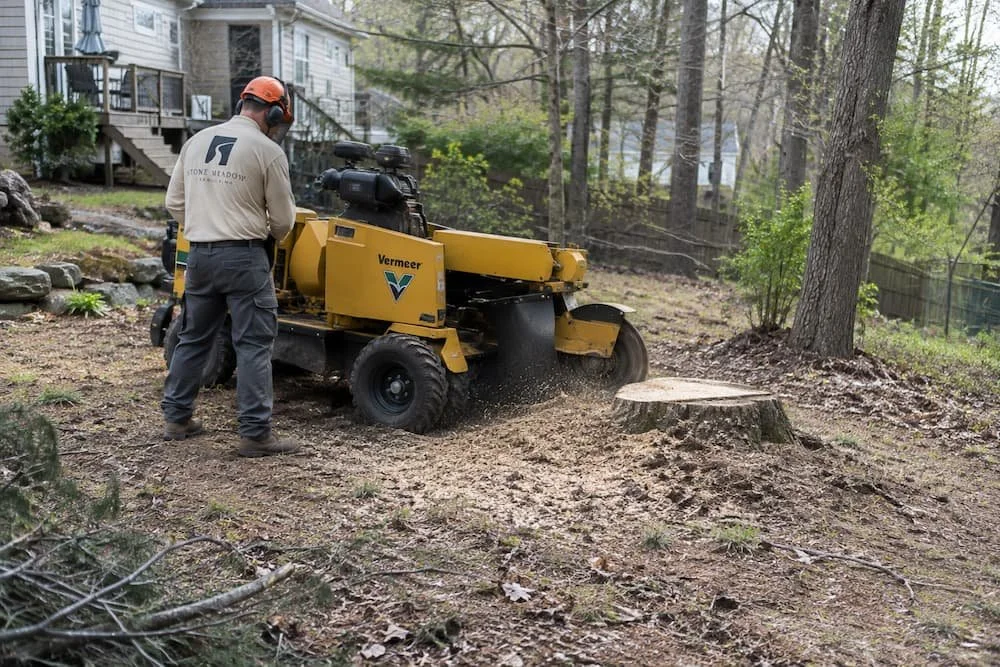
Safe Tree Removal and Stump Grinding, Even in Tight Back Yards
Sometimes a tree needs to come out because it's dead, diseased, structurally unsound or planted somewhere it was never going to fit. We handle tree removal and stump grinding, climbing to reach back yards and tight spaces that equipment can't, then restore the ground.
If a tree has you concerned, call and we'll come take a look.
Climbing Removals for Tight Spaces
Many trees that need removal aren't in open ground. They're behind the house, between structures, or surrounded by beds and lawn that took years to establish.
Climbing lets us take a tree down in sections from above without bringing heavy machinery across the property. Work near utility lines is handled by the utility or a line-clearance contractor. If you're unsure whether a mature tree can be saved, a certified arborist's assessment is worth getting before deciding on removal.
When a Tree Should Come Out
- Dead or declining, with a significant share of the canopy no longer leafing out
- Signs of structural risk: major cracks, a hollow trunk, a split where limbs meet, or a lean that has changed
- Root damage from construction or trenching that has affected stability
- Disease beyond what treatment can address
- A location that's undermining a foundation, retaining wall or septic system
- Storm damage too extensive to prune out
A leaning tree isn't automatically a problem. Many have grown that way for decades and are perfectly stable. What matters is whether the lean is new or increasing, and whether the soil is lifting on the opposite side of the roots.
Stump Grinding
Grinding removes the stump and major surface roots several inches below grade. It's faster and far less disruptive than digging a stump out, which takes a much larger machine and leaves a sizable hole.
How deep we grind depends on what the area will become. Lawn needs less depth than replanting. If you'd like a new tree in the same area, planting a few feet away from the old stump usually gives a better result, because the decomposing roots tie up nutrients in the soil.
Cleanup and Restoration
Wood, brush and grindings are removed and disposed of as part of the job. If you'd like logs cut to firewood length and stacked, we're happy to do that.
When the area is going back to lawn, we backfill with soil rather than grindings, since grindings settle as they break down and leave a dip within a year or two. Restoration is covered under lawn restoration.
Permits and Local Rules
Rules vary by town. Some require permits for removing trees above a certain size, some protect trees along public ways and scenic roads, and removals near wetlands require conservation review. Historic districts can add another layer. We check what applies and let you know if your removal needs a permit.
Common Questions
What does tree removal cost?
It depends on size, species, access and what's underneath. A tree in an open back yard is straightforward. The same tree over a roof, a fence or a patio has to be taken down carefully in sections and takes longer.
Can I plant a new tree in the same spot?
It's better to plant a few feet away. Roots left after grinding break down for years and tie up nutrients in the soil.
How soon can I put grass over a ground stump?
Once the area is backfilled with soil, right away.
How quickly can you look at it?
We return every inquiry within one business day. For storm damage or anything you think may be a hazard, let us know and we'll prioritize it.